2026

Bajaj Electricals Transforms Demand Planning with Karini AI's Agentic Forecasting Solution
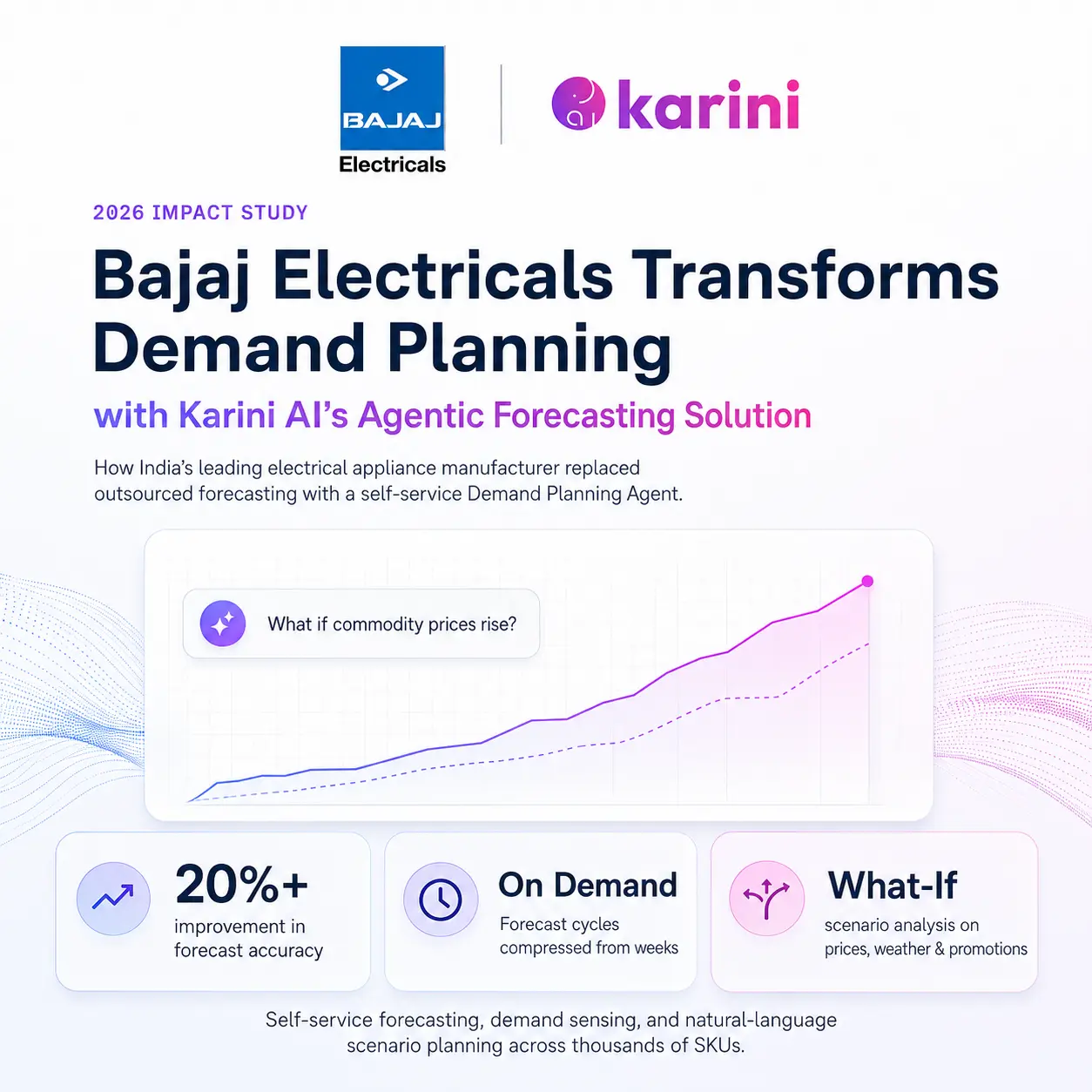
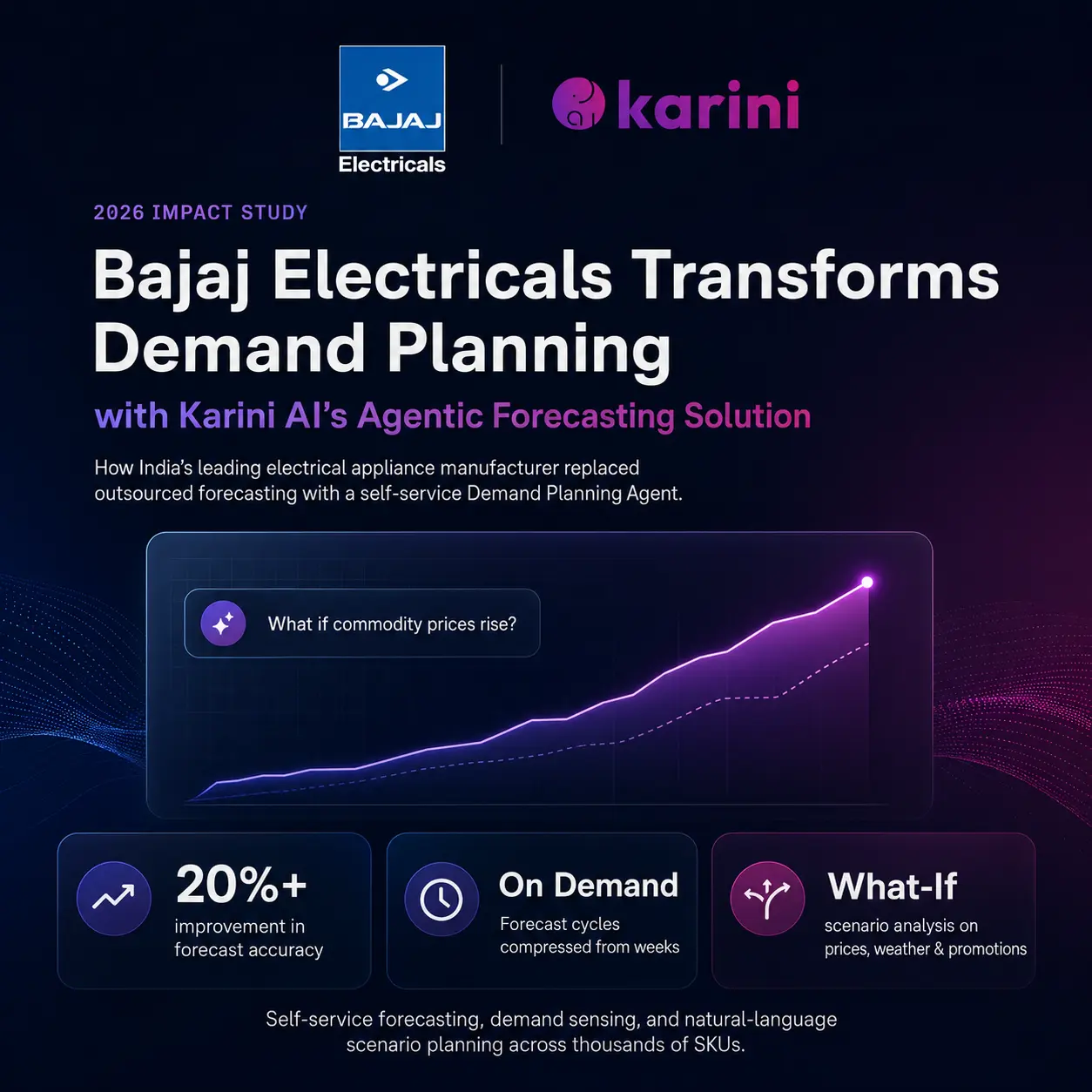
How India's leading electrical appliance manufacturer replaced outsourced forecasting with a self-service Demand Planning Agent, improving SKU-level accuracy by 20% and compressing forecast cycles from weeks to on-demand.
improvement in forecast accuracy
Forecast cycles compressed from weeks
scenario analysis on prices, weather & promotions
Overview
Bajaj Electricals, one of India's most recognized consumer electrical brands, relied entirely on outsourced data science teams for demand forecasting across its trade and alternate distribution channels. The process was slow, opaque, and brittle - every feature change, every model adjustment, and every what-if question required external intervention. When external shocks hit, such as an LPG shortage that triggered an unprecedented spike in induction cooker sales, the forecasting system had no mechanism to respond.
Working with Karini AI, Bajaj Electricals deployed a Demand Planning Agent that puts the planning team in direct control. The agent spans three capabilities: demand forecasting across thousands of SKUs, demand sensing for short-horizon adjustments using real-time signals like weather and commodity prices, and what-if analysis for stock-out and promotional scenarios.
The planning team now runs forecasts, diagnoses misses, and simulates scenarios through natural language — without a single data science ticket.
About Bajaj Electricals
Bajaj Electricals Limited is a flagship company of the Bajaj Group and one of India's most trusted consumer electrical brands. The company manufactures and distributes a wide portfolio of appliances including fans, coolers, lighting, kitchen appliances, and small domestic equipment through an extensive distribution network spanning thousands of distributors and retailers across India.
Challenge | Outsourced Forecasting with No Self-Service Capability
Bajaj Electricals' demand forecasting was entirely dependent on external data science teams. The planning team had no visibility into model logic, no ability to select or test features, and no mechanism to run what-if scenarios when market conditions changed.
This dependency created compounding problems. Forecast cycles took weeks from data preparation to final output. When commodity prices shifted or promotional schemes changed, the model couldn't adapt until the next cycle. Branch-level operational decisions, such as merging one plant operations into another plant or transitioning a 3PL partner in a different city, were invisible to the model and silently distorted results.
The model, trained purely on seasonal baselines with no commodity price signal, missed the category entirely. The planning team had no way to flag the anomaly, adjust the forecast, or simulate the downstream impact on adjacent categories of products.
Outcome | Measurable Transformation Across Forecasting Operations
20% Accuracy Improvement
SKU and distributor-level forecast accuracy improved by 20% through automated feature engineering incorporating weather, pricing, seasonality, and demand pattern classification across 70+ engineered features.
Weeks to On-Demand
Forecast cycles compressed from weeks of manual coordination with external teams to on-demand execution by the planning team. A full pipeline run across both channels completes in a single session.
Thousands of SKUs at Granular Level
The agent forecasts across thousands of SKUs in the trade channel and 7+ alternate subchannels (E-Commerce, CSD, Modern Trade, GEM, Institution, CPC) simultaneously, with parallel processing for both channels.
Self-Service Root Cause Analysis
Post-forecast analysis that previously required manual pivot tables and external data science support is now built into the agent. Product miss rankings, depot-level accuracy breakdowns, and root cause explanations are generated automatically.
Real-Time Scenario Planning
What-if analysis on commodity prices, weather events, and promotional scenarios is now available on demand, replacing a capability that previously did not exist.
Key Success Factors
Planning Team as the Operator
Moving control from outsourced data science to the internal planning team eliminated the longest bottleneck in the forecasting cycle, the handoff between business context and model execution.
Agentic Architecture with Guardrails
The agent automates the pipeline end-to-end but pauses at quality gates for human validation. This builds trust with the business while maintaining speed.
Feature Engineering Driven by Domain Knowledge
Incorporating weather, wedding and gifting seasons, monsoon flags, ASP, and demand pattern classification into the feature set brought domain expertise into the model systematically rather than as ad-hoc manual adjustments.
Automated Root Cause Analysis
Surfacing not just what the model missed but why, with actionable recommendations like "retrain with LPG price signal",closes the loop between forecast output and model improvement.
Technology & Platform Capabilities
Amazon SageMaker
Multi-model training and inference across Classical ML, Deep Learning, and Time Foundation Models with configurable compute instances.
Amazon Bedrock
LLM reasoning layer powering the conversational agent interface, root cause analysis, and what-if scenario generation.
Amazon S3
Centralized storage for weather data, ASP tables, promotional data, and ancillary signals feeding the feature engineering pipeline.
Apache Airflow
Orchestration of multi-stage forecast pipelines with parallel processing across trade and alternate channels.
Snowflake
Primary data warehouse providing daily-updated sales data across all channels and depots, with planned direct integration for automated data consumption.
Karini AI Platform
No-code Agentic AI platform providing the conversational interface, pipeline orchestration, quality gates, observability, and human-in-the-loop gating for the full demand planning workflow.
Learn more →