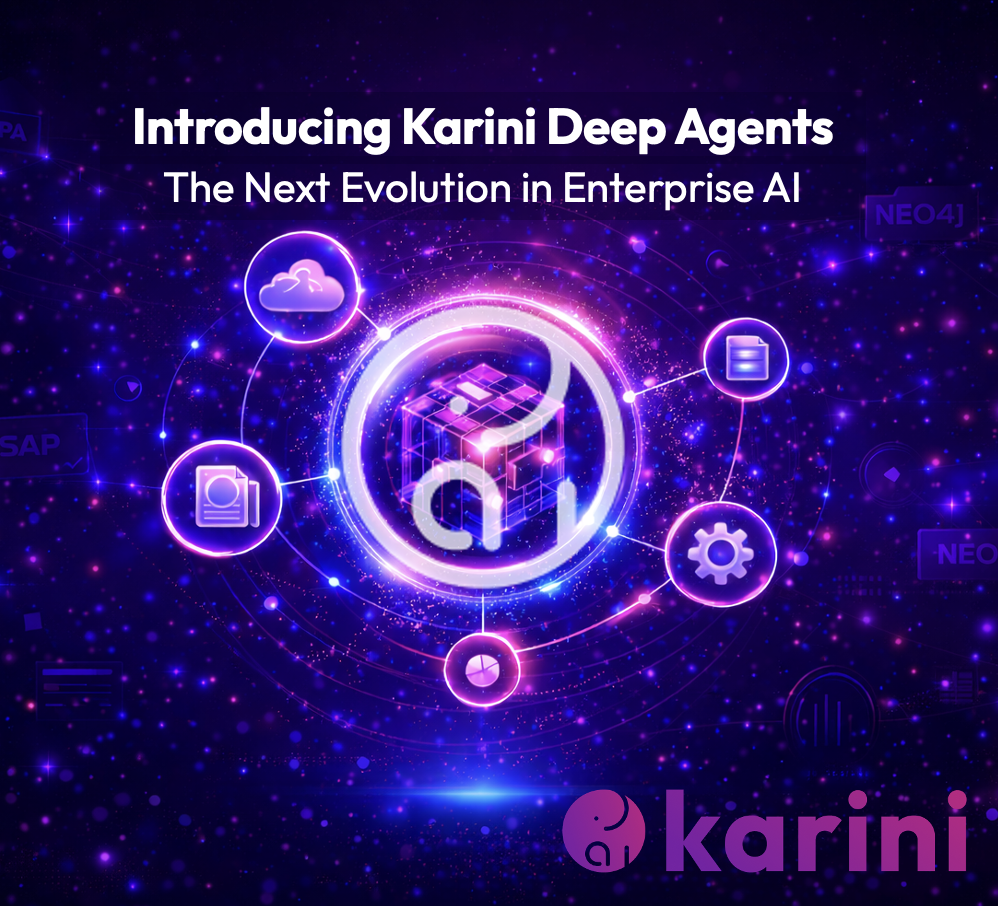
Enterprise leaders are sold a compelling vision: AI agents that can automate complex, multi-step business processes end to end. Summarize a 200-page regulatory filing. Orchestrate a cross-department RFP response. Run a due-diligence review that normally takes a team of analysts two weeks.
The reality? Most agent frameworks today break down the moment a task outgrows a single context window. When a workflow spans hundreds of pages, dozens of steps, and multiple sessions, conventional agents simply run out of room to think.
At Karini AI, we built Deep Agents to close that gap. Not with incremental improvements, but with a fundamentally different architecture designed for the long-horizon, high-stakes work that enterprises actually need AI to do.
Structured Agents: Strong Foundations, One Critical Ceiling
Karini AI Agent Workflows already deliver production-grade structured agents with the capabilities enterprises expect. Conversation history persists across turns. Guardrails enforce policy and compliance boundaries. Tool integration connects agents to enterprise systems. And full observability gives operators visibility into every decision an agent makes.
Karini customers are running structured agent workflows in production today, processing 300+ line item purchase orders for a manufacturing distributor and generating 30+ page coherent RFP responses for an engineering firm.
So structured agents work. The question is: where do they stop working?
The Long-Context Wall
The answer is scale. Structured agents operate within fixed context windows. For bounded tasks, such as answering a question from a knowledge base, drafting an email, or classifying a support ticket, they perform exceptionally well. But enterprise processes rarely fit neatly inside a single context window.
When a task requires reasoning across a 500-page contract, correlating data from dozens of financial filings, or maintaining coherence over a multi-day workflow with human review cycles, structured agents hit a wall. The context fills up, state is lost between sessions, and there is no mechanism to decompose, delegate, and reassemble work across multiple agent executions.
Karini AI Workflows address this with a Split/Merge approach, breaking large tasks into smaller chunks that individual agents can process. This works well for parallelizable tasks. But some workflows are inherently sequential, requiring an agent to build understanding over time, remember what it has already done, pause for human input, and pick up exactly where it left off.
That is the gap Deep Agents fill.
Deep Agents: AI That Works the Way Enterprises Do
Deep Agents are not a better chatbot. They are a new category: purpose-built AI agents designed for long-horizon, complex enterprise tasks that require persistent memory, human oversight, and full auditability.
Think of a Deep Agent as a project manager that can break a complex task into sub-tasks, delegate to specialist agents, pause for stakeholder input, remember everything across sessions, and document every decision it makes.
Where Deep Agents Unlock Value
-
RFP and Proposal Response. Ingest entire RFP documents, cross-reference requirements against your capabilities, draft section-by-section responses, and route each section for expert review.
-
Regulatory Compliance Review. Process large regulatory documents, extract obligations, map them to internal policies, flag gaps, and generate remediation plans with human approval at each critical stage.
-
Financial Due Diligence. Analyze financial statements, filings, and legal documents in parallel across sessions, assembling findings into structured reports that exceed any single context window.
-
Contract Analysis at Scale. Review portfolios of contracts, extract key terms, identify risk clauses, and flag deviations from standard templates with persistent memory across review sessions.
-
Order Processing and Fulfillment. Process complex, high-volume orders with hundreds of line items, validating inventory, pricing, and business rules across multiple backend systems.
-
Load Optimization. Analyze shipment data, warehouse constraints, and carrier capacity to generate optimized load plans that minimize cost and maximize utilization across a distribution network.
-
Demand Forecasting (Data Science Agent). Ingest historical sales data, market signals, and seasonal patterns to build and refine demand forecasts, iterating through multiple modeling cycles with analyst review at key decision points.
-
Technical Documentation Generation. Ingest codebases, API specs, and product requirements to produce comprehensive technical manuals with multiple refinement cycles and engineering review.
Karini AI Deep Agents: Architecture Built for the Enterprise
Karini Deep Agents are production-hardened from day one. Every capability described below is live, tested, and designed for the constraints of real enterprise environments.
-
Multi-Agent Orchestration with Sub-Agent Delegation
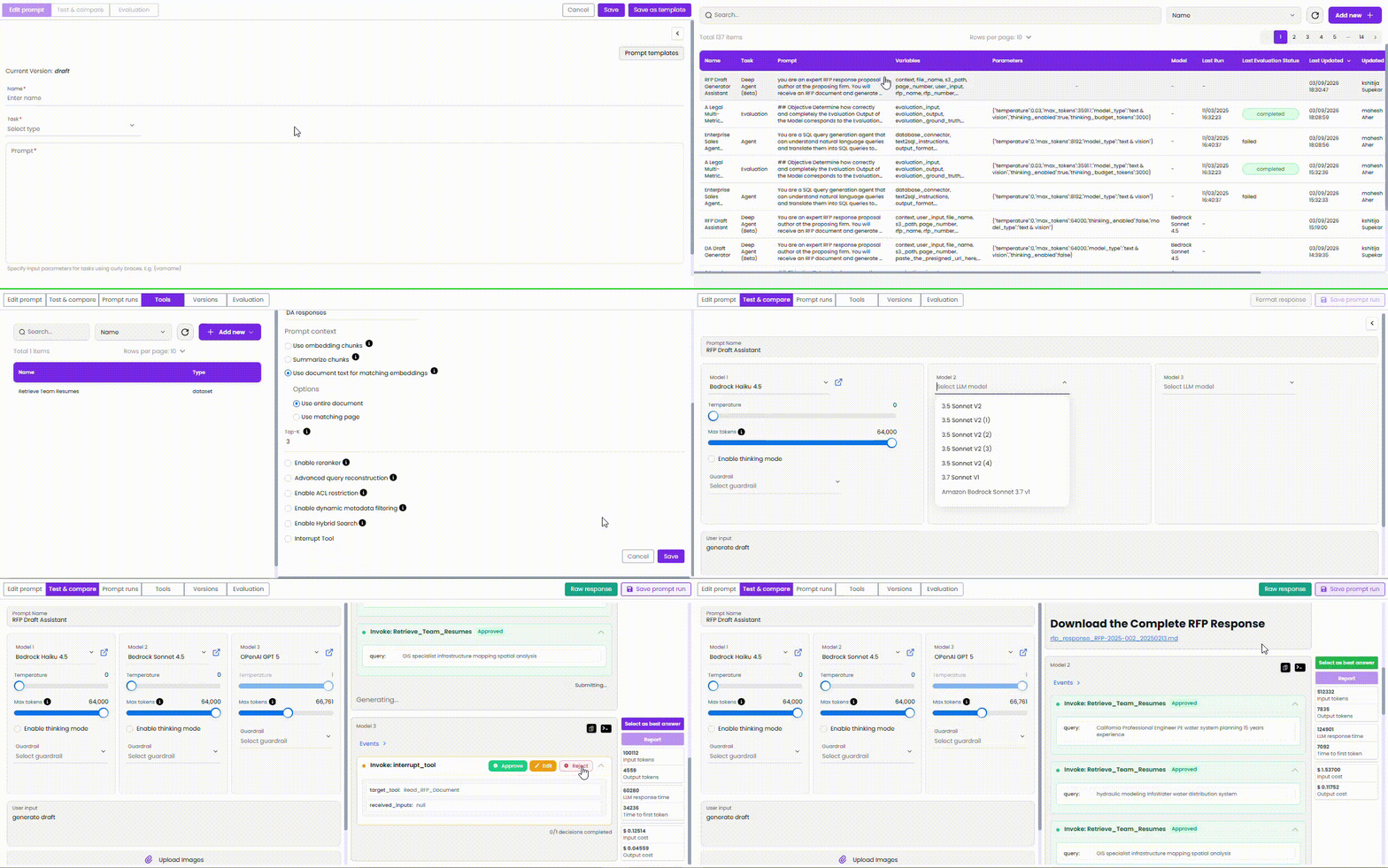
Complex tasks rarely have a single dimension. A Deep Agent can decompose a task into specialized sub-agents, each with its own LLM model, dedicated tool set, custom prompt template, and isolated execution context. Up to three sub-agents run concurrently, dramatically reducing end-to-end latency. Each sub-agent is a fully compiled agent graph, enabling true nested agentic reasoning.
-
Interrupt and Resume with Human-in-the-Loop
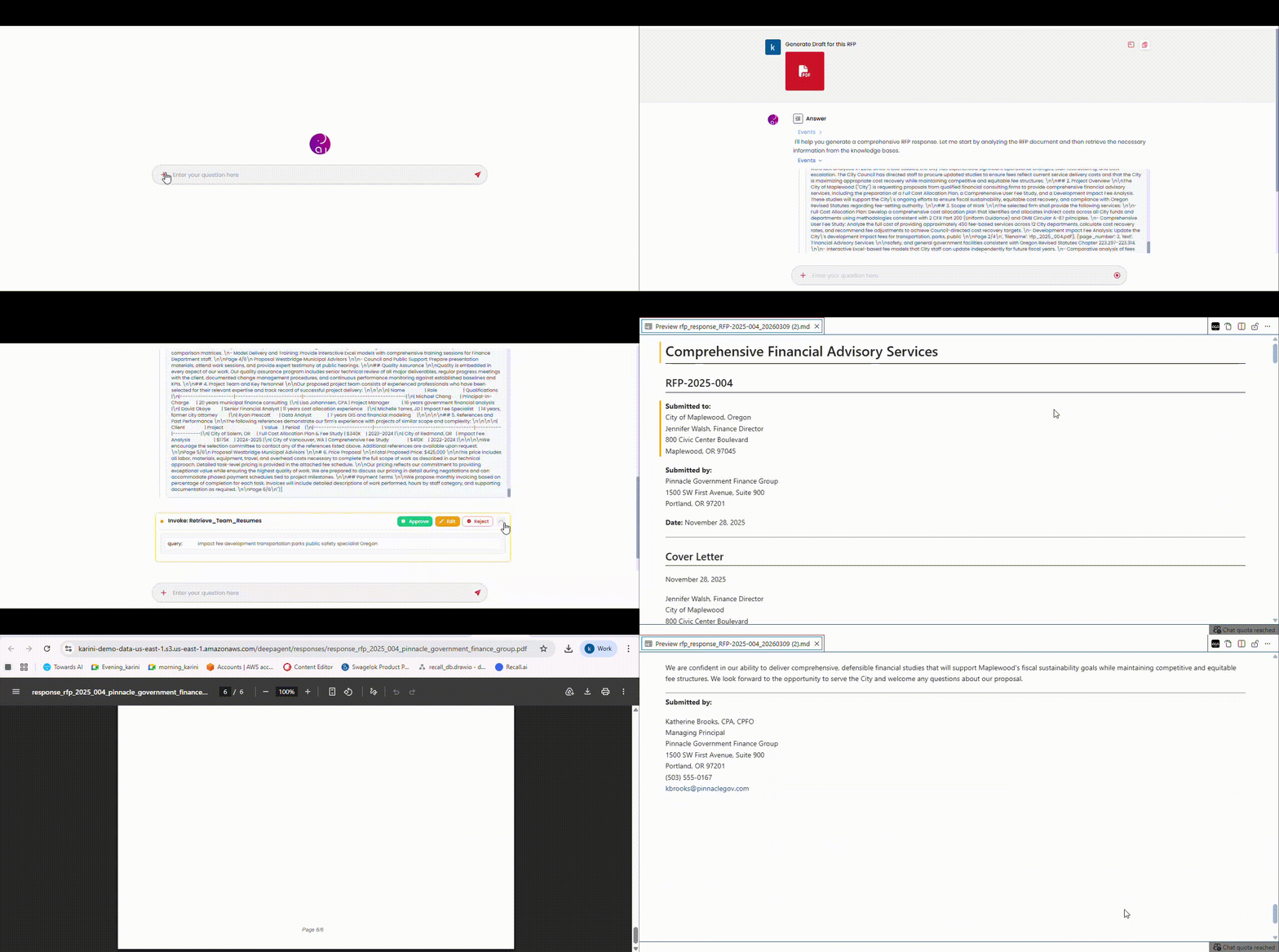
This is the trust feature. Deep Agents can pause mid-execution at configurable tool boundaries, present proposed actions to human reviewers, and resume seamlessly from the exact checkpoint after approval. Users can approve, edit, or reject any proposed action. Full execution state persists across sessions checkpointing, so no work is ever lost, even if a reviewer takes days to respond.
-
Persistent Agent Memory
Deep Agents maintain a persistent, namespaced virtual POSIX filesystem. Agents can read, write, edit, search, and list files across this filesystem, with built-in resource limits that prevent runaway consumption. Large tool outputs exceeding 20K tokens are automatically evicted to the filesystem, keeping the agent’s context window clean. Agents also maintain dedicated memory files and conversation history, enabling truly continuous multi-session workflows.
-
Real-Time Event Streaming
Every step of agent execution is streamed as live events. Users and operators can monitor reasoning, tool calls, and decisions in real time, providing full transparency into what the agent is doing and why. This is not post-hoc logging. It is a live window into agent cognition.
-
Full Observability and Auditability
Every agent execution is instrumented through Karini’s built-in observability. Traces enable fine-grained analysis, enabling full trace reconstruction of inputs, outputs, tool calls, token counts, and latency. Every agent decision is auditable, which is critical for regulated industries where explainability is non-negotiable.
-
Extensive Tool and Connector Support
Deep Agents come with a broad toolkit for interacting with enterprise systems and the wider world such as Knowledgebases and Knowledge Graphs. Enterprise connectivity is handled through custom MCP (Model Context Protocol) servers all initializing in parallel at startup. New connectors can be added without modifying core agent logic.
-
Configurable Iteration and Self-Correction
Agents can iterate through up to 100 reasoning-and-action cycles, refining their output progressively. This self-correction capability is ideal for complex, multi-step tasks where the first pass rarely produces the best result, much like a human analyst who drafts, reviews, and revises.
See It in Action: The RFP Responder
To demonstrate the power of Deep Agents in a real-world scenario, we have built an RFP Responder: a Deep Agent workflow that automates the most time-consuming parts of proposal response.
The RFP Responder ingests a complete RFP document regardless of length, decomposes it into individual requirements, cross-references each requirement against your organization’s knowledge base and past proposals, drafts section-by-section responses, routes critical sections to subject matter experts for human-in-the-loop review, and assembles a polished final proposal within a single orchestrated, auditable workflow.
Build and Test Deep Agent in Playground
Deploy and Test Deep Agent
The Shift: Structured Agents vs. Deep Agents
The table below illustrates how Deep Agents transform enterprise AI capabilities across the dimensions that matter most.
| Dimension | Structured Agents | Deep Agents |
|---|---|---|
| Task Complexity | Single context window tasks. Large documents require Split/Merge pre-processing. | Long-horizon, multi-session tasks. Agents manage their own memory and context across an unlimited scale. |
| Memory | Stateless between sessions. Each invocation starts fresh. | Persistent S3-backed memory across sessions. Agents recall prior work, decisions, and feedback. |
| Human Oversight | Run-to-completion execution. No mid-workflow pause capability. | Interrupt and resume at any step. Reviewers can approve, edit, or reject before the agent continues. |
| Document Scale | Limited by context window. Split/Merge needed for large inputs. | Native filesystem-backed processing. Agents page through, index, and selectively recall from documents of any size. |
| Session Continuity | State resets between sessions. | Full checkpoint persistence. Resume from the exact point of interruption, even days later. |
| Best For | Bounded tasks: Q&A, classification, summarization, single-document processing. | Complex workflows: RFP response, compliance review, due diligence, demand forecasting, load optimization. |
From Agents That Answer to Agents That Deliver
The enterprise AI conversation has been stuck in the chat window for too long. Organizations do not need a smarter chatbot. They need AI that can take responsible action across complex, long-running business processes.
Karini Deep Agents represent a fundamental shift: from stateless conversations to stateful operations, from single-turn answers to multi-session workflows, from black-box outputs to fully observable and auditable decision chains, and from isolated models to orchestrated teams of specialized agents working under human supervision.
This is not the future of enterprise AI. It is available today.
FAQ
What are Deep Agents and how are they different from standard AI agents?
Deep Agents are purpose-built AI agents designed for long-horizon, multi-session enterprise workflows. Unlike standard structured agents that are limited by a single context window and reset state between sessions, Deep Agents maintain persistent memory across sessions, support human-in-the-loop interruptions at any step, and can orchestrate multiple specialized sub-agents concurrently to handle tasks of unlimited scale.
What enterprise use cases are Deep Agents best suited for?
Deep Agents are ideal for complex, long-running workflows such as RFP and proposal response, regulatory compliance review, financial due diligence, contract analysis at scale, order processing with hundreds of line items, load optimization, demand forecasting, and technical documentation generation tasks that exceed a single context window and require human oversight at critical stages.
How does the human-in-the-loop feature work in Karini Deep Agents?
Deep Agents can pause mid-execution at configurable tool boundaries and present proposed actions to human reviewers. Reviewers can approve, edit, or reject any action before the agent continues. Full execution state is persisted checkpointing, so no work is lost even if a reviewer takes days to respond, enabling true human oversight without sacrificing continuity.