Vibe coding has its place. Cursor, Kiro, and the wave of AI-assisted dev tools have genuinely changed how individual developers ship code. But there's a quiet truth about that approach: it works because the human stays in the loop, catching the edge cases, testing as they go, discarding what doesn't work.
Enterprise agents don't get that luxury. They run unattended at scale, outlive the engineers who first built them, and fail in ways that affect customers. The looseness that makes vibe coding fast is the same looseness that makes it brittle at production scale.
Today we're introducing Kai, Karini AI's expert agent for designing, building, testing, and improving agentic workflows. Kai is built directly into Karini's Workflow Recipe canvas. Describe what you want in plain language, and Kai turns it into a working agentic workflow in minutes, with the prompts, tools, models, and structural rigor production demands.
This isn't another agent that writes agents. It's a spec-driven builder that brainstorms with you, plans the workflow, authors the system prompts, picks suitable models from your registered hub, and wires it all together, using the same conventions your team would use if they had a week to do it by hand.
Why Enterprise Agent Building Is Still Slow
AI agents have moved from novelty to infrastructure. Most of us are already using them: Cursor and Copilot for code, Claude and ChatGPT for thinking, Perplexity for what Google used to be. These platforms are excellent for ideation and one-off output.
They're also categorically not where you build enterprise agents.
Enterprise agents require things consumer platforms don't provide: carefully crafted system prompts, secure access to enterprise knowledge, built-in observability, scaling without per-seat economics, and version control over both logic and models. The closest tools, Cursor, Kiro, and similar are great for code generation but treat agentic workflows as glorified scripts. There's no clean answer for productionization, and certainly none for post-production maintenance.
So enterprise teams either spend months hand-crafting agents and the testing scaffolding around them, or they ship vibe-coded workflows and discover the cost on the second incident.
Karini AI was built for the middle path: a platform for building, testing, and nurturing agents at scale. Auto-prompting handles the authoring. Meta-prompting handles optimization. Built-in version control means logic and models can be upgraded or rolled back at the node level or the workflow level. Observability shows you what's happening in production so you can keep improving.
But even with that platform, building agents was still slow. A single enterprise workflow can run 15-20 agents, or one deep agent coordinating multiple sub-agents. Authoring and testing each piece, then composing them that's still hours of work, every time. We watched our builders go through this loop enough times to know the answer wasn't a better tool. It was an expert agent that already knew how to do this.
That's Kai.
What Kai actually does
Kai handles three core scenarios for AI builders today.
Build a new agentic workflow from an idea
Tell Kai what you want "build me a customer support agent that handles refunds and routes complex cases to a human" and it asks the right clarifying questions, plans the workflow structure, builds the nodes, generates the prompts, and tests them. You get a complete, runnable workflow on the canvas, not a sketch.
Update an existing workflow for new scenarios
Workflows evolve. New requirements come in, edge cases emerge, scope expands. Kai can take an existing workflow and modify it in place adding nodes, rewiring routes, updating prompts without forcing a rebuild. It studies the existing design first, preserves what's working, and changes only what needs to change.
Upgrade the LLMs Powering Your Agents
Models improve fast. The workflow you built six months ago on one model probably runs better, cheaper, or both on a newer one. Kai knows what's in your model hub and can swap models at the node or workflow level, with the version control to roll back if the new model regresses.
Under the hood: Kai's architecture
Kai is itself a Deep Agent, an architectural choice that gives it three things it needs to operate well: a large persistent context, conversation history kept in a file system rather than rehydrated each turn, and modular skills it can load on demand instead of carrying everything in the system prompt.
Here's how the pieces fit together:
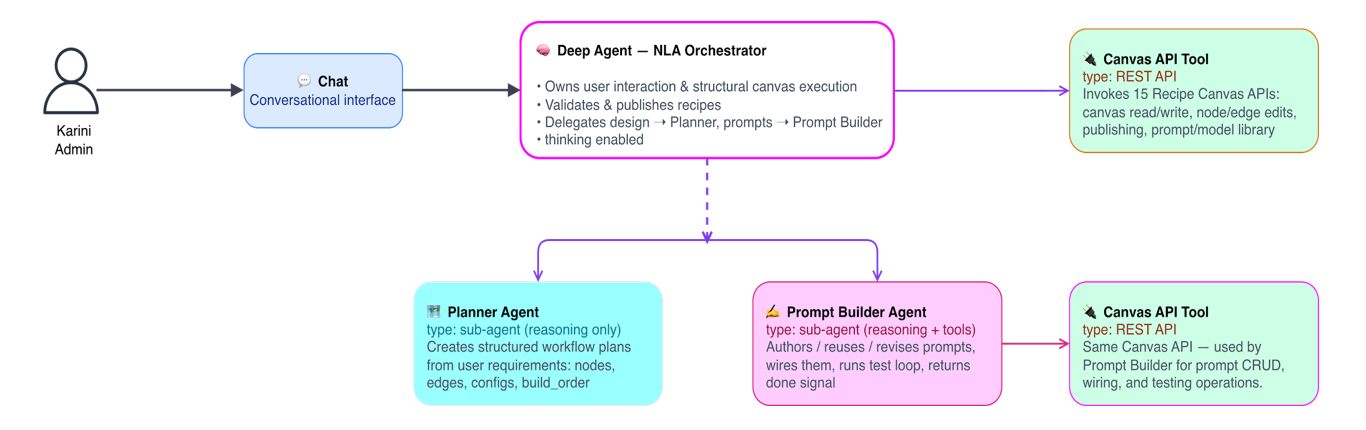
Chat is the entry point. A user describes what they want in natural language, and the Chat node routes the conversation into the orchestrator.
The Deep Agent is the brain. It owns the user conversation, decides what needs to happen, executes structural changes on the canvas itself, validates the result, and publishes the final recipe. Thinking is enabled, so it reasons before it acts.
It delegates to two specialists. The Planner Agent, reasoning only, turns fuzzy user requirements into a concrete workflow plan: nodes, edges, configurations, and build order. The Prompt Builder Agent, reasoning plus tools, handles everything prompt related: authoring, reusing, revising, wiring, and testing prompts.
The Canvas API Tool is the write layer. It's a REST tool exposing the Recipe Canvas API that cover canvas reads and writes, node and edge edits, publishing, and the prompt and model library. Both the Deep Agent and the Prompt Builder have their own attached instance: the orchestrator drives structural changes, the Prompt Builder drives prompt CRUD and testing.
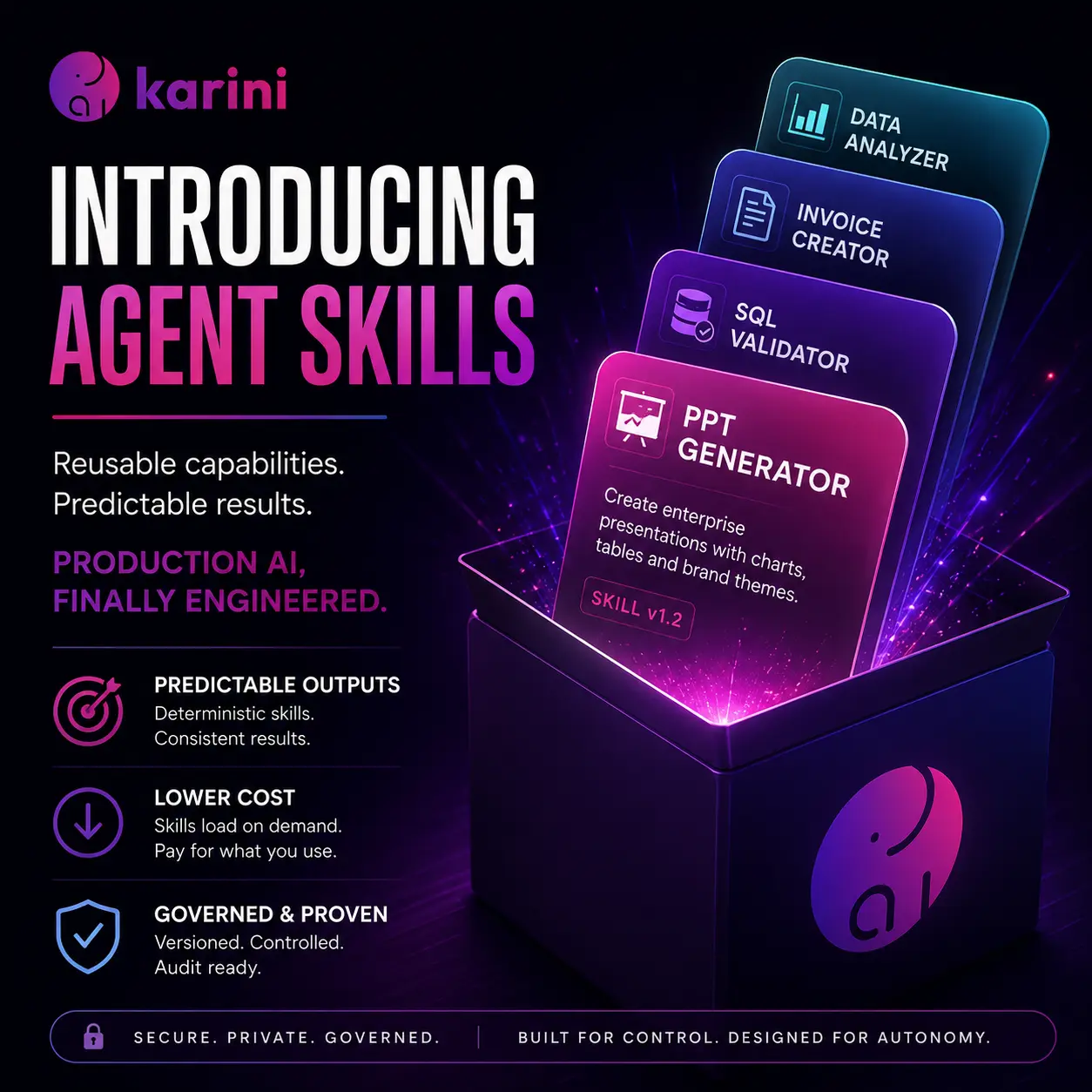
The Skills Library is Kai's playbook. Agent Skills for Requirements Gathering, Schema Design, Node Creation Playbook, Validation, Deployment, Canvas API Reference, Node Schema Reference are loaded into context on demand. The hard rule: the relevant skill must be in context before any Canvas API call. Kai never works from memory alone.
The pattern is simple to describe and effective in practice: a thinking orchestrator, two narrow specialists, a single REST surface to the canvas, and a skills library that grounds every action. That's how natural-language intent becomes a validated, published agentic workflow.
For teams building their own domain-specific expert agents, Kai is also a working example of the pattern. Same Deep Agent shape, different skills, different sub-agents and you have an expert for legal contract review, sales operations, supply-chain triage, or whatever else your enterprise needs.
The Future of Enterprise Agent Building
Vibe coding will keep its place for individual experimentation. But the future of enterprise agent building isn't another IDE that suggests prompts faster. It's expert agents that know how to build other agents that absorb your enterprise's conventions, your choice of models, your existing applications and produce production-grade workflows on demand.
Kai is our first answer to that thesis. Over the coming months we'll be expanding what Kai can compose, deepening the skills library, and connecting Kai more tightly to the observability signals from production agents so the workflows it builds tomorrow are informed by how the workflows it built yesterday actually performed.
Building enterprise agents shouldn't take longer than describing them. Karini AI is making that real, today without giving up the rigor production demands.
FAQ: Kai, Spec-Driven Agent Building, and Deep Agents
What is Kai in Karini AI?
Kai is Karini AI’s expert agent for designing, building, testing, and improving agentic workflows on the Workflow Recipe canvas. You describe the agent you want in natural language, and Kai turns that intent into a working, validated workflow with the right nodes, prompts, tools, and models for production use.
What does “spec driven agent building” mean?
Spec driven agent building means starting from an explicit specification of what the agent should do, how it should behave, and how the workflow should be structured, rather than incrementally vibe coding from the REPL. Kai takes that specification, plans the workflow graph, chooses models and tools, and applies changes through the canvas in a repeatable, reviewable way that fits enterprise standards.
How is Kai different from vibe coding tools like Cursor or Kiro for AI agents?
Vibe coding tools are optimized for individual developers who stay in the loop, quickly testing and discarding code as they go. Kai is built for unattended enterprise agents that run at scale: instead of generating ad hoc scripts, it uses a spec driven Deep Agent architecture, a Canvas API, and a Skills Library to design, evolve, and maintain full agentic workflows on a shared platform.
What problems does Kai solve for enterprise AI and engineering teams?
Kai shortens the time from “we need an agent that does X” to a production ready workflow by automating planning, node creation, prompt authoring, and canvas edits. It also helps teams safely update existing workflows and upgrade underlying LLMs without a ground up rebuild, while preserving observability and version control over both logic and models.
What can I build with Kai as an enterprise agent workflow builder?
Kai handles three core scenarios: building new agentic workflows from an idea, updating existing workflows for new requirements and edge cases, and upgrading the LLMs that power your agents at the node or workflow level. In each case, it plans the changes, edits nodes and edges through the Canvas API, and validates the resulting Recipe before publishing it to run in production.
What is a Deep Agent and how does Kai use Deep Agent architecture?
A Deep Agent is an agent architecture with large persistent context, file backed conversation history, and modular skills that are loaded on demand instead of being hard wired into a single static system prompt. Kai uses this Deep Agent architecture so it can reason before acting, keep track of multi step changes to complex workflows, and reuse specialized skills for planning, prompt building, validation, and deployment.
How do the Planner Agent and Prompt Builder Agent work inside Kai?
Inside Kai, the Planner Agent is responsible for structure: it turns fuzzy user requirements into a concrete workflow plan with nodes, edges, configurations, and build order. The Prompt Builder Agent focuses on prompts and tools: it authors, reuses, revises, wires, and tests prompts and model calls for each node. The Deep Agent orchestrator coordinates both specialists and applies their changes to the canvas through the Canvas API.
How does Kai update existing enterprise AI workflows without breaking them?
When you ask Kai to extend an existing workflow, it first analyzes the current Recipe and loads the relevant skills for requirements gathering, schema design, node creation, and validation from its Skills Library. It then modifies the workflow in place, adding nodes, rewiring routes, and updating prompts only where needed, while using version control and validation to preserve what already works.
What is the Canvas API and why is it important for spec driven agent building?
The Canvas API is a REST interface that exposes operations on Karini’s Workflow Recipe canvas, including reading and writing workflows, editing nodes and edges, managing prompts and models, and publishing Recipes. Kai and its sub agents use the Canvas API as the single write layer, so every structural and prompt change is explicit, auditable, and aligned with the same conventions your human builders use.
What is in Kai’s Skills Library?
Kai’s Skills Library contains agent skills and reference materials for requirements gathering, schema design, node creation playbooks, validation, deployment, the Canvas API reference, and node schema reference. Skills are loaded into context only when needed, and Kai must have the relevant skill in context before it makes any Canvas API calls, so it does not rely on memory alone for critical workflow changes.
How does Kai support version control and observability for enterprise agents?
Kai builds and edits workflows on top of Karini’s platform, which provides built in versioning, testing, and observability for Recipes and agent runs. When Kai publishes a workflow, that Recipe inherits node and workflow level version control and production traces, so teams can roll back logic or models, inspect how agents behave, and keep improving them over time.
Can I reuse the Kai Deep Agent pattern to build my own domain specific expert agents?
Yes. The same Deep Agent pattern that powers Kai can be applied to other expert agents by changing the skills, tools, and specialist sub agents attached to the orchestrator. Enterprises can use Kai as a working example of how to structure a spec driven agent builder with a thinking orchestrator, narrow specialists, a single REST surface to the workflow canvas, and a skills library that grounds every action.
Who is Kai for inside an enterprise?
Kai is designed for teams that already treat AI agents as infrastructure: platform teams, data and AI engineering groups, and product teams that own mission critical agentic workflows. It is especially useful where workflows involve many agents or deep agents coordinating sub agents, and where observability, governance, and long term maintenance matter as much as initial speed.