Enterprises are no longer asking whether to deploy agentic AI, they're racing to put it into production across procurement, customer service, manufacturing, and the back office. But as AI moves from experiment to critical infrastructure, it inherits a threat surface that traditional software security was never designed to cover. The pipelines that build, train, and serve modern AI systems have quietly become one of the most attractive targets in the enterprise, and most organizations don't yet realize how exposed they are.
The risk is structural. A modern AI application is assembled from a deep stack of third-party parts: pre-trained model weights pulled from public hubs, open-source frameworks and tokenizers, vector databases, fine-tuning adapters, configuration files, and managed services chained together at runtime. The OWASP GenAI Top 10 now lists supply chain vulnerabilities as a distinct, top-tier category (LLM03:2025) precisely because these dependencies behave differently from ordinary software. A model is a binary black box, you cannot read it the way you read source code, so a poisoned model, a backdoored dependency, or a tampered dataset can sit in production behaving perfectly normally until the moment it doesn't.
That is what makes AI supply chain attacks so dangerous. A compromised library still looks like a legitimate library. A poisoned model passes its evaluations. An over-permissive deployment looks like a productive one. Attackers don't need to breach an entire pipeline, they only need to compromise one trusted link, and the supply chain propagates the damage downstream into every application that depends on it. The consequences are not theoretical: a corrupted fraud-detection model that silently ignores certain transactions, a data-exfiltration payload embedded in a downloaded model file, or a single compromised base model cascading into hundreds of fine-tuned derivatives across an organization.
Securing enterprise AI, therefore, isn't about hardening one component. It's about establishing verifiable trust across the entire chain and proving it.
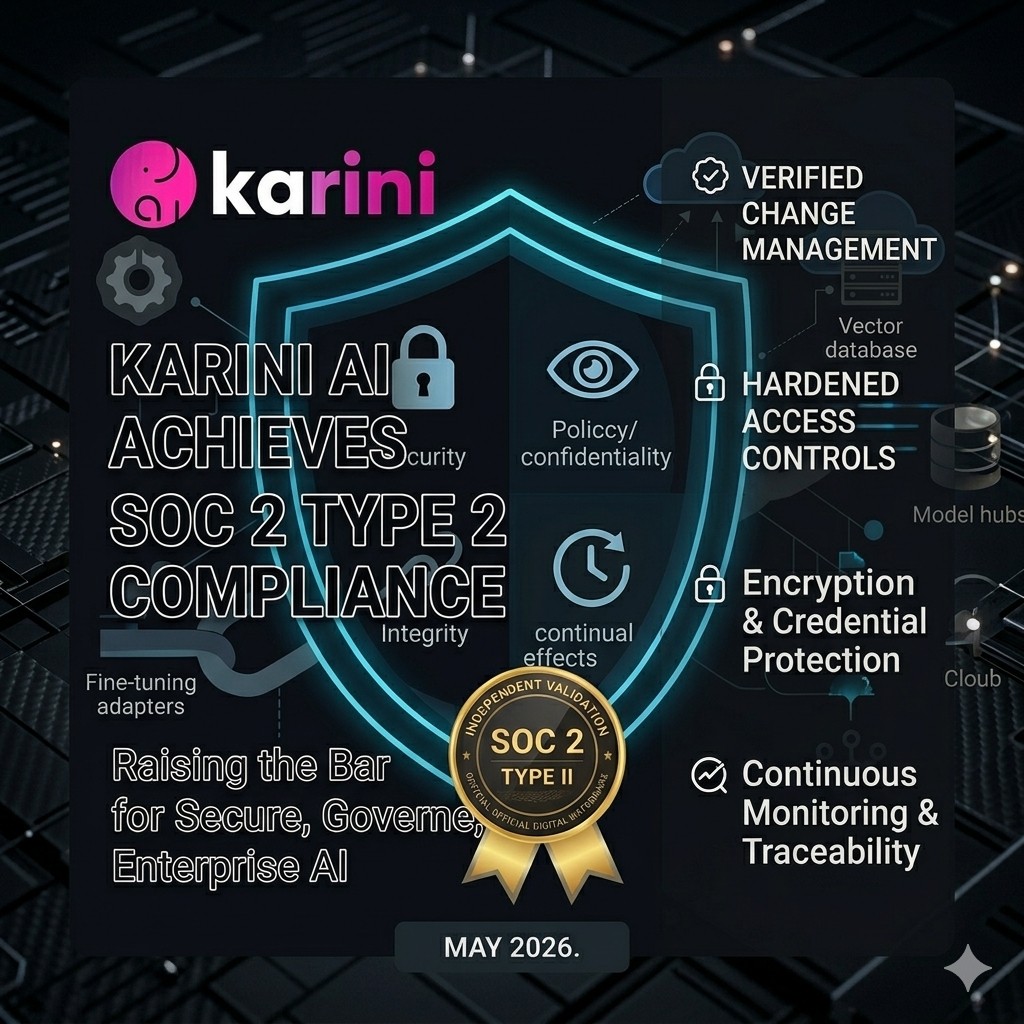
Today, we're proud to announce that Karini AI has achieved SOC 2 Type II compliance.
This milestone is independent, third-party validation that the controls protecting our platform aren't just designed well on paper, they operate effectively, continuously, over time. Unlike a point-in-time attestation, SOC 2 Type II evaluates how our security, availability, processing integrity, confidentiality, and privacy controls perform across an extended audit window. For our customers, it transforms "trust us" into "here's the evidence."
Security and governance have been foundational to Karini AI since day one. Our platform was built with enterprise controls at its core, encrypted credential vaults, role-based access control (RBAC), PII masking, Access Control List (ACL) aware data processing, OAuth 2.0 secured MCP server access, and end-to-end observability across usage, performance, and cost. As a signatory of the Cloud Security Alliance's AI Trustworthy Pledge, we've committed publicly to building AI that organizations can rely on. SOC 2 Type II is the formal, audited expression of that commitment.
Why This Matters for the AI Supply Chain
SOC 2 Type II directly strengthens the defenses that matter most against supply chain threats. The audit scrutinizes the practices that determine whether a poisoned dependency, a tampered artifact, or an unauthorized change can ever reach production:
Verified change management. Every change to our platform follows controlled, reviewed, and auditable processes, closing the door on the unvetted dependencies and silent code injections that supply chain attackers depend on.
Hardened access controls. Least-privilege access, strong authentication, and continuous monitoring limit the blast radius if any single credential or component is compromised, the exact failure mode behind the largest supply chain breaches of the past year.
Encryption and credential protection. Data is encrypted in transit and at rest, and secrets live in a managed vault, removing the soft targets attackers pivot to once they gain a foothold.
Continuous monitoring and traceability. Comprehensive logging and tracing across pipelines mean anomalous behavior is detectable in context, rather than hiding inside "trusted" components until it's too late.
Vendor and component governance. Formal oversight of the third-party services and software we rely on extends scrutiny upstream where AI supply chain risk actually originates.
Together, these controls don't just check a compliance box. They establish the provenance, integrity, and accountability that AI systems require but traditional security postures often miss.
Built for the Cloud and for Your Infrastructure
Here's what makes this milestone especially meaningful for our customers: the benefits don't stop at our cloud.
While SOC 2 Type II formally certifies the controls governing Karini AI's own cloud infrastructure, the engineering rigor behind it lives in the software itself. The same hardened build and release processes, the same secure-by-default configurations, the same dependency discipline and integrity checks that earned the attestation are baked into every deployment of Karini AI including the platform deployed inside our customers' own environments.
For organizations that run Karini AI in their VPC or on-premises, common in manufacturing, public sector, legal, and other regulated industries, this means the software arrives pre-hardened. You inherit a stronger security posture, a smaller attack surface, and supply chain discipline that has been independently examined, no matter where the platform runs. Compliance certifies our cloud; the resulting software hardening protects you everywhere.
Trust as a Foundation for Innovation
As agentic AI takes on more autonomous, high-stakes work, the organizations that win will be the ones that can move fast and prove they're secure. Security and governance aren't a tax on innovation, they're what make ambitious AI deployments possible in production at all.
SOC 2 Type II is a milestone, not a finish line. We'll continue to invest in independent validation, deepen our trust-and-safety controls, and harden every layer of the AI supply chain so that our customers can build, deploy, and scale generative AI with confidence.
Build Secure, Governed AI with Karini AI
Ready to deploy enterprise AI on a foundation you can trust? Schedule a demo to see how Karini AI combines no-code agentic workflows with enterprise-grade security and governance or talk to our team about deploying a SOC 2–hardened platform inside your own infrastructure.
FAQ
What is SOC 2 Type II compliance and why does it matter for AI platforms?
SOC 2 Type II is an independent, third-party audit that evaluates whether a company's security, availability, processing integrity, confidentiality, and privacy controls operate effectively over an extended period typically six to twelve months. Unlike a Type I report, which is a point-in-time snapshot, Type II provides continuous evidence. For AI platforms, it means customers can verify that the controls protecting their data and workloads aren't just designed correctly, they have been tested and proven to work in production over time.
How does SOC 2 Type II address AI supply chain security risks?
SOC 2 Type II audits scrutinize change management, access controls, vendor governance, and monitoring practices, all of which directly target supply chain attack vectors. Verified change management closes the door on unvetted dependencies and code injections. Hardened access controls limit the blast radius of any compromised credential or component. Vendor governance extends scrutiny upstream to the third-party models, libraries, and services that AI applications depend on. Together, these controls establish provenance and integrity across the full AI supply chain.
Does Karini AI's SOC 2 Type II certification cover on-premises and VPC deployments?
SOC 2 Type II formally certifies the controls governing Karini AI's cloud infrastructure. However, the security engineering behind the certification, hardened build and release processes, secure-by-default configurations, and dependency discipline, is baked into the software itself. Organizations deploying Karini AI in their own VPC or on-premises environment inherit this pre-hardened posture, a smaller attack surface, and supply chain discipline that has been independently examined, regardless of where the platform runs.
What security controls does Karini AI have built into its platform?
Karini AI's platform includes encrypted credential vaults, role-based access control (RBAC), PII masking, Access Control List (ACL) aware data processing, OAuth 2.0 secured MCP server access, and end-to-end observability across usage, performance, and cost. These controls are foundational to the platform, not bolt-on additions, and form the basis of the SOC 2 Type II audit.
How can I request a copy of Karini AI's SOC 2 Type II report?
Existing and prospective customers can request a copy of the SOC 2 Type II report through Karini AI's security team. Contact us via the website or reach out to your account representative. We share the report under a standard NDA to ensure confidentiality.
Is Karini AI involved in any other security or compliance frameworks?
Yes. Karini AI is a signatory of the Cloud Security Alliance's AI Trustworthy Pledge, committing publicly to building AI that organizations can rely on. The company also aligns with OWASP GenAI Top 10 guidance, particularly around supply chain vulnerabilities, and continues to invest in independent validation and additional compliance certifications.